

Most Common Steels Used in Process Piping Industry
Common Materials Used in the Piping Industry
In the piping industry, various grades of steel are the most prevalent materials. C&N Group produces piping products using these steel grades. Below are some of the materials we utilize:
1. Carbon Steel
Carbon steel is the most widely used material in the piping industry. It is commonly employed in refineries, chemical plants, and process facilities, especially in neutral or aqueous solutions. Carbon steel can withstand temperatures ranging from -29°C to 427°C. This category includes high-strength carbon steels and low-temperature carbon steels (LTCS), with LTCS suitable for temperatures as low as -46°C.
One notable type of carbon steel is killed carbon steel, which is thoroughly deoxidized during the melting process. This results in a cleaner and higher-quality product with fewer air bubbles compared to standard carbon steels.
2. Low Alloy Steel
Low alloy steels contain one or more alloying elements that enhance mechanical strength, temperature resistance, and corrosion resistance compared to carbon steels. For instance, chromium (Cr) and silicon (Si) improve hardness and abrasion resistance, while nickel (Ni) enhances toughness and corrosion resistance at low temperatures. Molybdenum (Mo) ensures high strength at elevated temperatures, with these steels typically performing well from -29°C to 593°C.
Some common low alloy steels include:
- 0.5% Mo: Ideal for high-temperature applications, particularly for intermediate temperatures due to its resistance to hydrogen attack.
- 0.5% Cr, 0.5% Mo and 1.25% Cr, 0.5% Mo: These alloys offer enhanced resistance to hydrogen attack and sulfur corrosion, suitable for services exceeding the rated temperature of 0.5% Mo steel.
- 2.25% Cr, 1% Mo and 3% Cr, 1% Mo: These alloys provide greater resistance to hydrogen attack and higher strength at elevated temperatures than the previous group.
- 5% Cr, 0.5% Mo: Frequently used to protect against combined sulfur attacks at temperatures above 550°F, offering better hydrogen attack resistance than 2.25% Cr, 1% Mo.
- 9% Cr, 1% Mo: Primarily used for heater tubes, this alloy offers superior resistance to high sulfur stocks at elevated temperatures.
3. Stainless Steel
In addition to carbon and alloy steels, stainless steels are also commonly used in piping applications due to their corrosion resistance and ability to withstand high temperatures. They can be easily fabricated into complex shapes and typically operate within a temperature range of -257°C to 538°C.
Stainless steels are categorized into three main types:
- Martensitic Stainless Steel: Containing 12-20% chromium and controlled amounts of carbon and other additives, martensitic alloys (e.g., Type 410) can be hardened through heat treatment, enhancing tensile strength. However, their corrosion resistance is lower than that of austenitic stainless steels, making them suitable for mild corrosive environments.
- Ferritic Stainless Steel: Comprising 15-30% chromium with low carbon content (0.1%), ferritic steels (e.g., Type 430) have improved corrosion resistance due to their higher chromium content. Their strength can be increased through cold working, but not via heat treatment. Type 430 is commonly used in nitric acid plants and is highly resistant to scaling and high-temperature oxidation up to 800°C.
- Austenitic Stainless Steel: This group is the most corrosion-resistant, containing 16-26% chromium and 6-22% nickel, with a low carbon content (maximum 0.08%) to minimize carbide precipitation. Welding can lead to chromium carbide precipitation, reducing corrosion resistance, especially in nitric acid environments. This issue can be mitigated through heat treatment (solution annealing) or by using stabilized steels (Types 321, 347, and 348) or low carbon stainless steels (Types 304L and 316L).
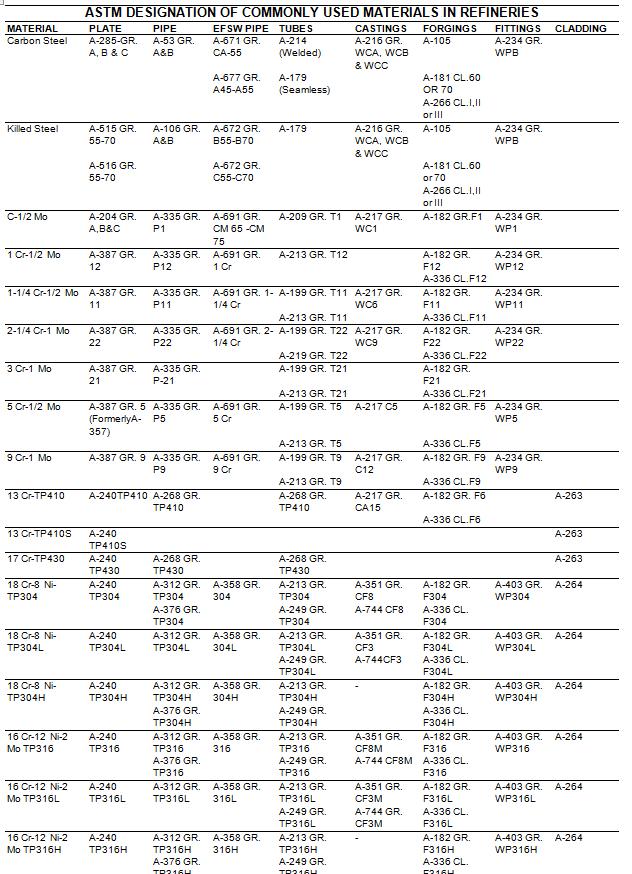
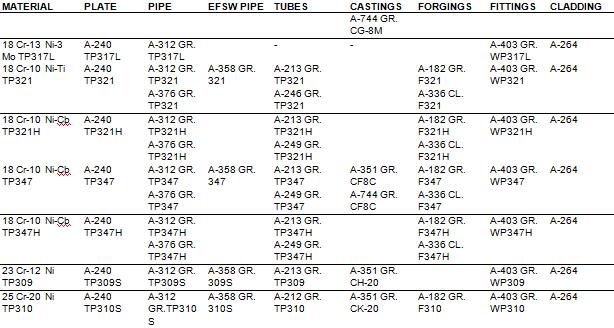
The detailed list of common steel materials used in the piping industry is provided below:
Most Common Steels Used in Process Piping Industry

Leave A Comment